|
| Home » Trading » Market Making |
|
Trading » Market-Making
|
|
|
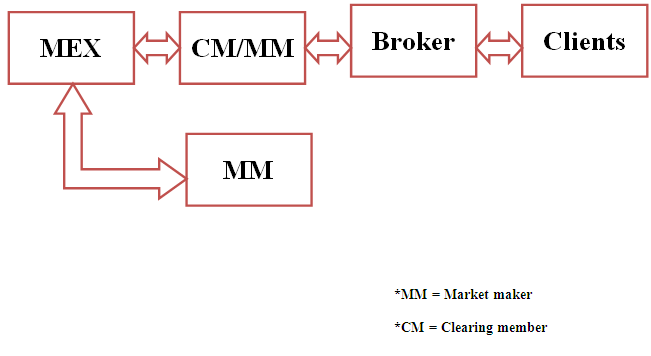
Generally speaking, any Clearing Member acts as a Market Maker and takes part in the Market-Making programs and packages that are offered. All CMs are automatically checked to evaluate whether they fulfill Market Maker Obligations and if so, they will benefit from market segment.
For selected futures products, so-called "Designated" Market-Making is available. Market Makers take on defined obligations to increase liquidity in their chosen product. Subject to their performance in fulfilling their obligations, members are rewarded with a reduction in their fee levels.
- Market Maker Protection Tool
The Market Maker Protection Tool is aimed at preventing too many simultaneous trade executions on quotes provided by a Market Maker, offering additional control of the market risk.
The basic principle can be envisioned as a counter, counting the number of traded contracts per product on Market Maker's quotes within a time frame of some seconds that the Market Maker can define.
Once the time has elapsed the counter is set to zero and restarted. If the counter reaches or exceeds a threshold level defined by the Market Maker, all remaining quotes are put on hold. Market Makers can define three threshold values in the counter:
- Volume: total number of contracts
- Vega: absolute number of contracts purchased reduced by the number of contracts sold
- Market-Making Heartbeat
The Market-Making Heartbeat limits the operational risk of continuously quoting Market Makers. A predefined "Keep Alive" signal between the Market Maker's quote machines dedicated to this purpose, via the respective integrated security to the MEX back-end, delivers protection against technical failure of either the customer software or the MEX infrastructure. An interruption of the signal triggers immediate deletion of all remaining quotes entered by this subgroup, if no further signal arrives within a preset period of time.
- Account Structure
MEX provides several position accounts where a transaction may be kept until it is closed out. There are three types of accounts:
- Customer account
- CM/Market Maker accounts
- Member accounts
Every order entered into the MEX system must be associated with one of these account types.
Customer's accounts are kept on a gross basis. If a trader buys and sells identical contracts, s/he will have both a long position and a short position in the same account, unless the second trade is designated as a closing transaction. If an offsetting transaction is not marked as a closing transaction during entry, the designation can be adjusted later. If this is not done in a timely fashion, additional fees will be charged by MEX.
Market Maker accounts are kept on a net basis.
- Customer Account
Trades entered into the MEX system on behalf of clients are recorded as customer account. All give-up trades are considered part of this account and are displayed as such trades. The account codes are actually designations that the trade is going to be sent to another Member, usually when a client uses one Member to perform the execution and another to do the clearing.
- CM/Market Maker account
In designating a trade, the trader provides all the information necessary for the give-up at order entry, including the Clearing Member ID of the firm to which the take-up is being transferred. The give-up then happens automatically, assuming that the CM involved has not specified that give-ups will be approved manually.
Trades resulting from quotes entered by market makers and from quotes by exchange participants in futures trading are recorded in the market maker accounts.
- Member Account (Non-Clearing member):
These accounts are available for trades made for the participant's own account. The participant has full discretion over which account is used for an opening position, although close-outs must be directed to the same account as the open position.

- Final Settlement
On the expiry of the futures contracts, the settlement procedure followed as seller's option. The pay-in/pay-out for settlement is by way of debit to the buyer and credit to the seller to the relevant CM's clearing bank account on T+1 day (T=date of allocation of settlement).
Position then the highest price of the contract during its currency is taken for cash settlement in marking all undelivered outstanding position to final settlement price. Resulting profit/loss settled in cash. Final settlement loss/profit amount is debited/credited to the relevant Clearing Member's clearing bank account on T+2 day. (T=expiry day).
|
|
| |
|
|
|