|
|
|
| Page Hits : 11152 |
|
 |
Mercantile Exchange Blog |
 |
 |
| |
Feb 29 2012 |
| The Proust Index: Nations Lost in Recession |
It has almost been five years when the recession began taking the world by storm and coining the financial Armageddon of the new millennium. Yet the economic crisis rumbles on to this day sparking speculations that the recession is but over. In order to assess how much economic progress it has undone, The Economist had constructed a measure of lost time for hard-hit countries. It exudes that Greek’s economic clock has been turned back the furthest i.e. it has rewound by over 12 years. America, where the recession started, has lost ten.
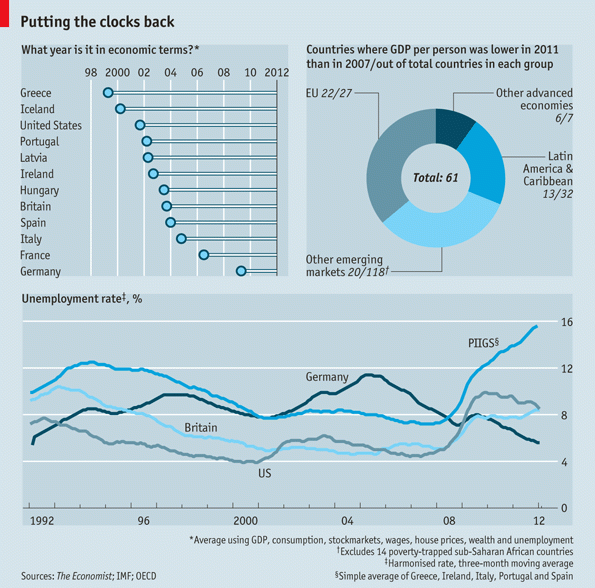
The clock uses seven indicators of economic health, which fall into three broad categories. Household wealth and its main components, financial asset prices and property prices are in the first group. Measures of annual output and private consumption are in the second category. Real wages and unemployment make up the third one. A simple average of how much time has been lost in each of these categories produces our overall measure.
House prices have gone backwards. The average American homeowner is living in 2001, judging by inflation-adjusted property values. Britain has suffered less dramatic drops in house prices, but still has lost seven years. Measures of output tend to crawl, not jump. The nominal GDP is a vital metric of government’s debt sustainability. There are 14 countries that have gone back in time, according to the nominal GDP indicator. The labor-market indicators provide more estimates of lost time. The OECD, a think-tank, publishes wage data for 25 rich countries. In ten of them real wages were lower in 2010, with four years lost on average by those that went backwards. Unlike income and GDP, there is no reason why unemployment statistics should improve year on year. However, in USA, the unemployment rate stands at 8.3%, the level vis-à-vis in 1983. In Britain it is at its worst for 17 years. In the euro area, job prospects are diverged hugely. While unemployment is falling in Germany but Greece, Ireland and Portugal have jobless rates not witnessed since the early 1990s.
These measures are the most worrying of them all. Growth will reset the economic clock, providing new jobs and resources to pay down debts. But periods of unemployment will scar workers even after economies have crawled back to health. For some, the time lost to the crisis will never be recovered. Will the economies leap into economic prosperity or further fall into the economic ruins of yesteryears? A penny for you thought!
|
|
|
| Posted by at 12:41:03 PM |
| -------------------------------------------------------------------------------------------------------------- |
|
| Leave a Reply |
 21 Visit(s) |
|
|
|
|
| |
0 Comment(s) |
|
|
Blog Home |
|
 |
|
|
 |
|
|
|
|
|


